A last-mile robot has to move a parcel from a local site to a door without blocking a sidewalk, missing a handoff, or needing a person at every turn. That sounds like a short route. The hard part is making the route work across weather, traffic, building entrances, and different delivery rules.
- A useful trial needs route length, payload, and human-intervention data.
- Cameras, LiDAR, remote control, and locking boxes shape the service.
- A robot that works on one planned route may fail on a mixed public route.
What the robot must do
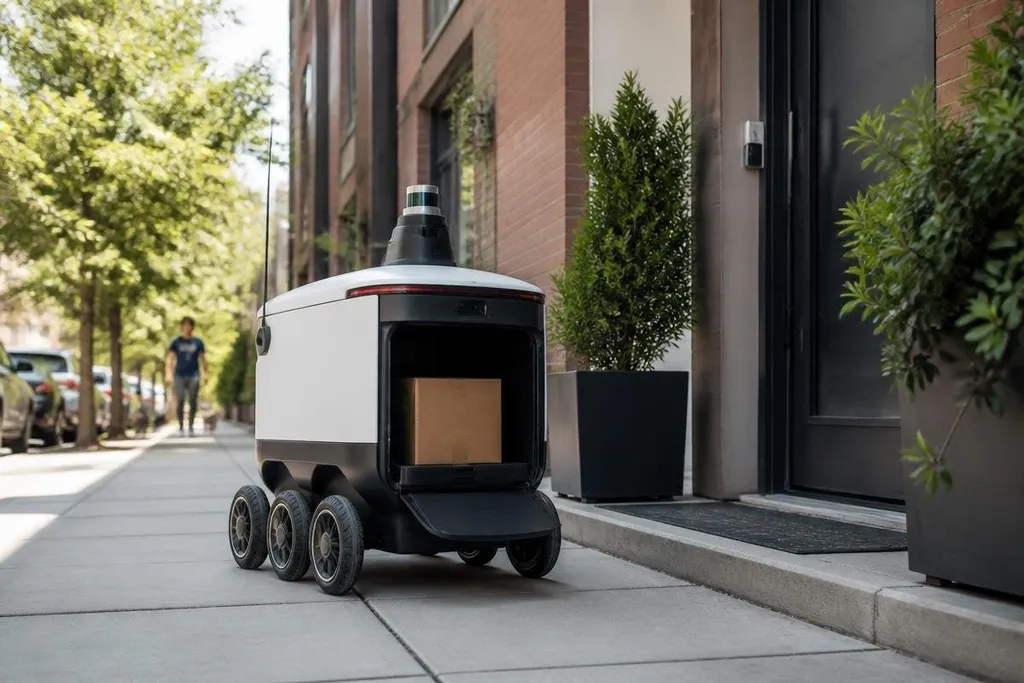
The basic job is clear: carry goods, move safely, stop at the right place, and let the customer collect the parcel. The system may use cameras, LiDAR, GPS, and wheel sensors to locate itself and avoid people or objects. LiDAR measures distance with light pulses, so the robot can build a map of nearby walls, curbs, and other objects.
That hardware only helps if the robot can deal with ordinary problems. A parked vehicle can block a curb ramp. A delivery point can have a locked gate. Rain can cover a camera lens, and a person may leave a box in the robot's path. Each event adds work for the control system or for a remote operator.
The useful measure is not a smooth demo. It is the number of human interventions per 100 deliveries, recorded across a stated route and time period. A trial that gives no intervention count leaves the main labor question unanswered.
The route decides the design
For a private campus, the robot has a different job from one using public sidewalks. The campus may have mapped paths, known access points, and staff who can move obstacles. A public route brings more people, changing road work, uneven paving, bicycles, pets, and doors the robot cannot open.
Route length matters too. A 2 km trip with a 5 kg payload places different demands on motors and battery life than a short trip carrying a small meal. Reports should name the distance, load, speed, charging plan, and weather conditions. Without those details, “successful delivery” says very little.
The handoff can cause its own delay. A locked compartment protects the parcel, but the customer needs a code or app. A failed phone connection can leave the robot waiting at the curb. That waiting time belongs in the trial record because it affects how many trips one robot can make in a day.
One missed curb handoff can erase the time saved on the route. A buyer weighing a last-mile robot can use Robot24 reports to compare the promised trip count with the route, handoff method, test date, and wait time. Those figures lead into the business test, where a robot has to earn its place on the street.
The business test is harder
A service needs more than a working machine. The operator must pay for the robot, charging equipment, repairs, software, remote supervision, insurance, and staff who handle exceptions. The delivery price also has to fit the local market.
The labor number deserves close attention. If one remote worker watches one robot at a time, the service may need many people. If one worker can safely supervise several robots, the cost may change.
That ratio should be reported with the task type and intervention rules, since a worker watching a quiet campus faces a different load from one handling busy sidewalks.
Robot makers may focus on speed or battery size. Those figures matter, but reliability during the last 100 m can matter more. Reaching the building quickly still leaves the robot needing a workable path to the customer.
What remains unproven
The global race has no single test that settles the question. Each city sets its own rules, sidewalks vary, and operators may define a completed delivery in different ways. That makes direct comparison difficult unless reports use the same measures.
I'd judge a last-mile robot by its intervention rate and cost per completed delivery before its top speed. Those numbers connect the hardware to the service a customer actually pays for.
Use this checklist before treating a deployment claim as proof:
- Name the route: record the distance, surface, crossings, and access points.
- Record the load: list parcel weight, box size, and the number of stops.
- Count interventions: separate remote advice from direct remote control.
- Check the clock: include loading, waiting, charging, and customer handoff time.
- Price the service: count hardware, staff, repairs, software, and site costs.
- State the limit: note weather, route rules, and tasks the robot did not try.
The next useful comparison will come from trials that publish these figures across several routes, not from another short video of a robot reaching one doorstep. Until those records exist, the race is mainly a contest of claims, and the missing number is still cost per completed delivery.